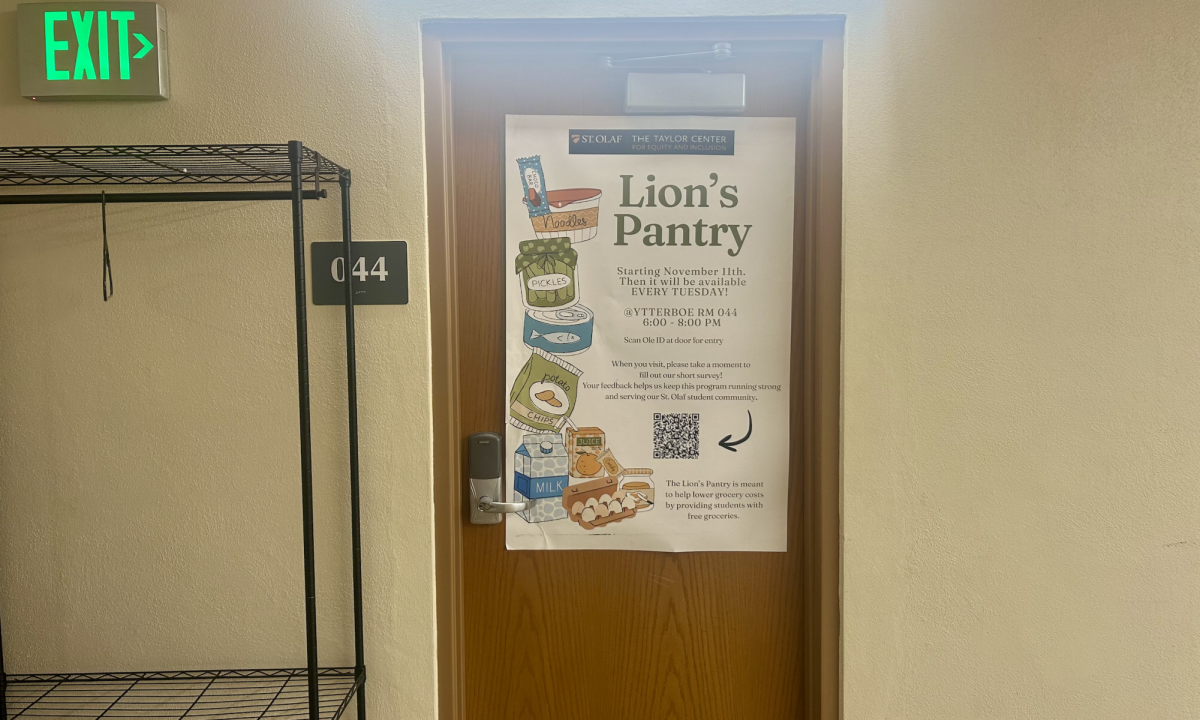
The United States Department of Agriculture (USDA) announced in a notice on Oct. 26 that no Supplemental Nutrition Assistance Program (SNAP) benefits will be issued for the month of November, leaving local food shelves to find ways to assist their community.
In Northfield, the food shelf is run by the Community Action Center (CAC), a nonprofit human resources organization servicing Rice County. The CAC helps provide food to 4,000 individuals on SNAP and people who fall under Asset Limited, Income Constrained, and Employed (ALICE). When it comes to food assistance, the question that the CAC is facing now is how can they make up the $600,000 worth of SNAP benefits distributed monthly in Rice County.
“I think what people don’t understand about SNAP is that for every one meal that a food shelf can provide, SNAP provides nine,” CAC Senior Director Anika Rychner said in an interview with The Olaf Messenger. “What’s happening right now, with the government being shut down and people not being able to access benefits, is sending people to their local food shelf.”
Almost 18,000 people come to the CAC food shelves already. Now, with the freezing of SNAP, more individuals will be coming to their doorstep. In response to this increase, Governor Tim Walz announced on Oct. 27 that $4 million in emergency state funding will be allocated to food shelves statewide. However, the CAC is looking for additional help to prepare and ensure that there is enough food to go around.
In a letter to the community, the CAC stated that they will need to raise $100,000 for November and then $200,000 if the government shutdown bleeds into December.
“We’re asking the community to walk alongside and contribute financial donations,” Rychner continued. “We can stretch a dollar at this point six to one. So for every six dollars that you would spend in a grocery store, the CAC can buy the same thing for one dollar.”
Beyond monetary donations that can be made on their website, the CAC is looking for shelf-stable items such as canned goods, peanut butter, and jelly, as well as any culturally-relevant foods.
On a national level, action has been taken to push the federal government to unfreeze funding for SNAP.
Minnesota joined 25 other states on Oct. 28 in suing the USDA for failing to utilize contingency funds — money reserved for emergencies such as a government shutdown — in order to keep the program running.
Two federal judges have also ruled over the weekend that the Trump administration must access the USDA’s contingency funds to resume full or partial payment of SNAP benefits for November.