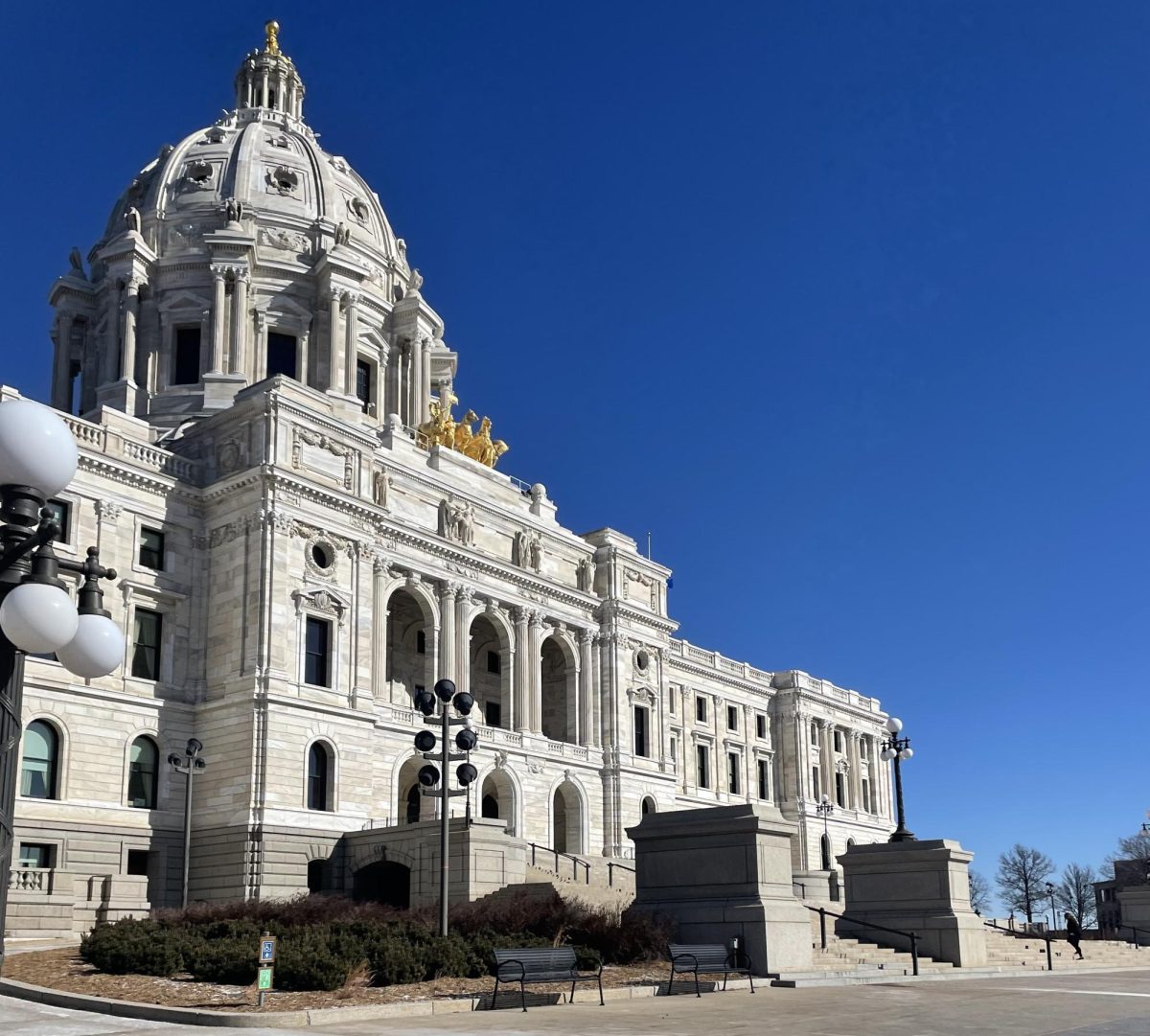
St. Olaf College students — alongside students from seven other Minnesota private colleges — traveled to the state capitol on March 10 to speak with legislators in hopes of increasing funding for the Minnesota State Grant, a state-funded financial aid program similar to the Pell Grant, for the 2026-27 academic year. Students part of the program can expect a cut of 30% or more to their grants if a raise is not passed this legislative session.
The colleges’ lobbying day at the capitol is in partnership with Minnesota Private College Council (MPCC) — an organization that serves 18 private, nonprofit colleges in the state, including St. Olaf. Their mission is to share the needs of these colleges and advocate for public policy that supports students at these institutions. This includes lobbying for need-based financial aid like the Minnesota State Grant.
“We want students to be able to share their stories about how the state grant helps make college work for them, whatever that looks like,” MPCC Advocacy and Communications Coordinator Olivia Brammer said in an interview with The Olaf Messenger.
Since 1969, the Minnesota State Grant has provided need-based financial aid for Minnesotans attending public or private colleges and universities. It serves as the largest financial aid program in the state, as 75,700 Minnesotans receive the grant. According to a 2026 State Grant Flyer from the MPCC, 56% of BIPOC and Indigenous students are scholarship recipients.
“The state grant helps make college affordable for students, who have fewer family resources to afford college,” MPCC President Paul Cerkvenik said in an interview with The Olaf Messenger. “It’s important in our society for everyone to have the opportunity to earn a college degree in whatever field of study they want to do and whatever institution is right for them.”
Importantly, the Minnesota State Grant’s funding is not being cut — the shortfall is mainly due to an increase in college enrollment. According to the Minnesota Office of Higher Education, roughly 7,400 more Minnesotans are enrolled in higher education. Currently, the Minnesota State Grant is expecting to see a shortfall of $131 million for the 2026-27 academic year as the program attempts to allocate funds for all students.
“With the shortfall, it could mean that students will have to get a second or third job that might cause them to be less engaged in the St. Olaf community, or they might have to drop out of college altogether,” Madi Dinneen ’27 said in an interview with The Olaf Messenger. Dinneen is a part of a public policy class taught by Visiting Assistant Professor of Political Science Kimberly Carr, who attended the MPCC lobbying event.