Dr. Nick Longo, director of the Rutgers Democracy Lab and professor at the Bloustein School of Planning and Public Policy at Rutgers University, began his “Naming and Framing Issues” workshop on March 4 with a quote from author Beverly Tatum: “You can’t solve a problem if you can’t talk about it.”
This workshop was organized and facilitated by the Svoboda Center for Civic Engagement and was centered on kickstarting conversations. Director of the Svoboda Center for Civic Engagement Alyssa Melby spoke about how this workshop factors into the Svoboda Center’s goals.
“With the launch of the Svoboda Center, we’re trying to do more programming for students to build their civic skills, understanding, and engagement with the public at large,” Melby said in an interview with The Olaf Messenger.
Participants began the workshop by asking one another questions from a list titled “36 Questions for Civic Love.” The questions ranged from “Can you keep a plant alive?” to “What law would you change for the betterment of your community?”
“The hope was to have an interactive, participatory, engaging conversation about some of the public skills that are really useful for dialogue across lines of difference,” Longo said in an interview with The Olaf Messenger.
The questions helped to establish common ground among participants, even on subjects that may seem polarizing.
“Different people name issues differently based on their lived experiences and their expertise. So, how do you frame questions in ways that will actually open up and invite conversation, invite stories, rather than close it down?” Longo said.
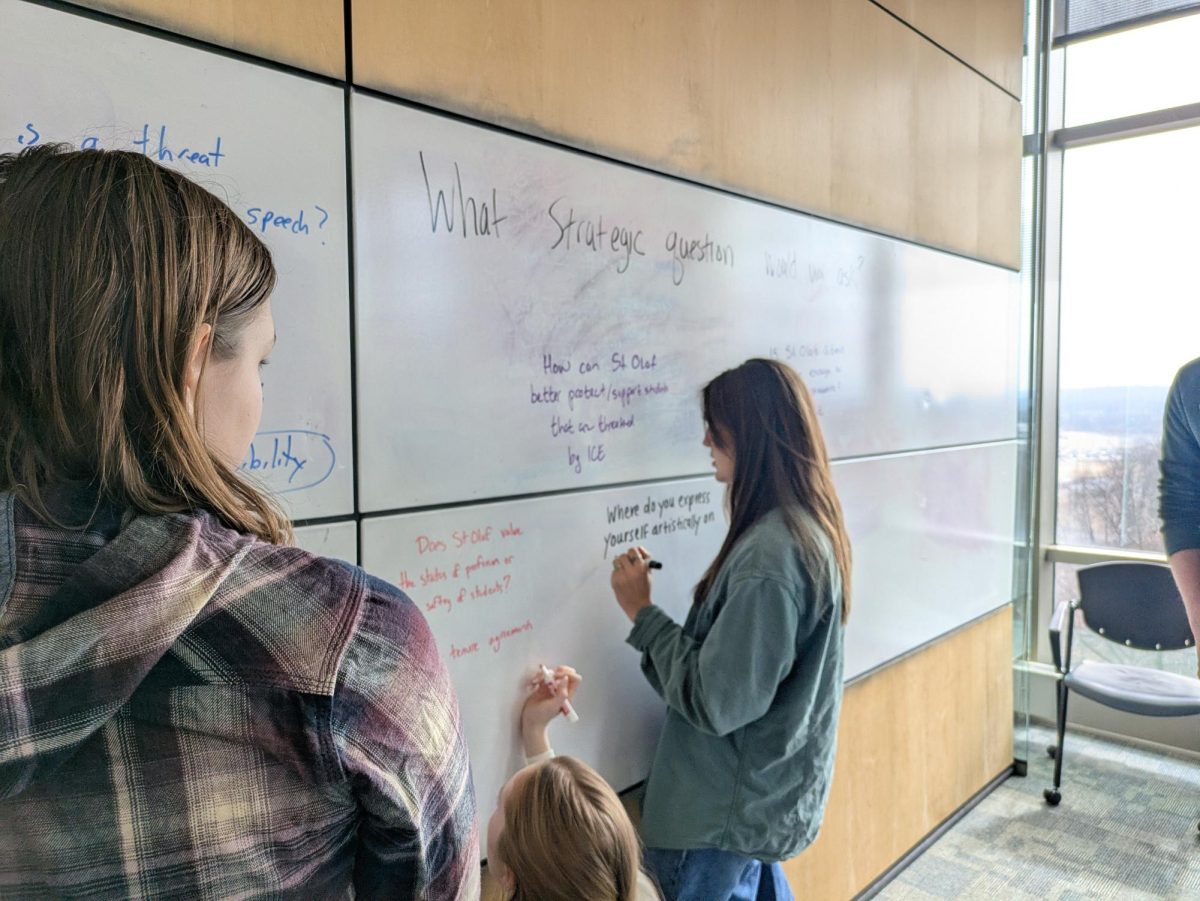
During the discussion, Longo highlighted a tool that can be helpful for facilitating conversation in community spaces: the democracy wall. Democracy walls gained popularity during the Democracy Wall Movement in Beijing, China in 1978 and are used all across the world today, serving as public forums for expression by allowing people a space to write down and share ideas. Melby spoke about the history and possible future of democracy walls at St. Olaf College.
“We had used Nick [Longo]’s model of the Dialogue Inclusion and Democracy Wall in the Flaten art exhibit in the fall of 2024, and it’s been something that we’ve talked about keeping on as an ongoing thing here at St. Olaf,” Melby said.
Through this workshop, Longo and the Svoboda Center hope to provide tools for students to use to engage with their communities.
“My favorite thing to do is to be in conversation with college students and young people, because I think you all have a sense of what’s possible,” Longo said. “What I’m hoping is that workshops like this give you some of the concrete skills to be able to say, ‘I envision the world differently, and now I have some skills to make that happen.’”