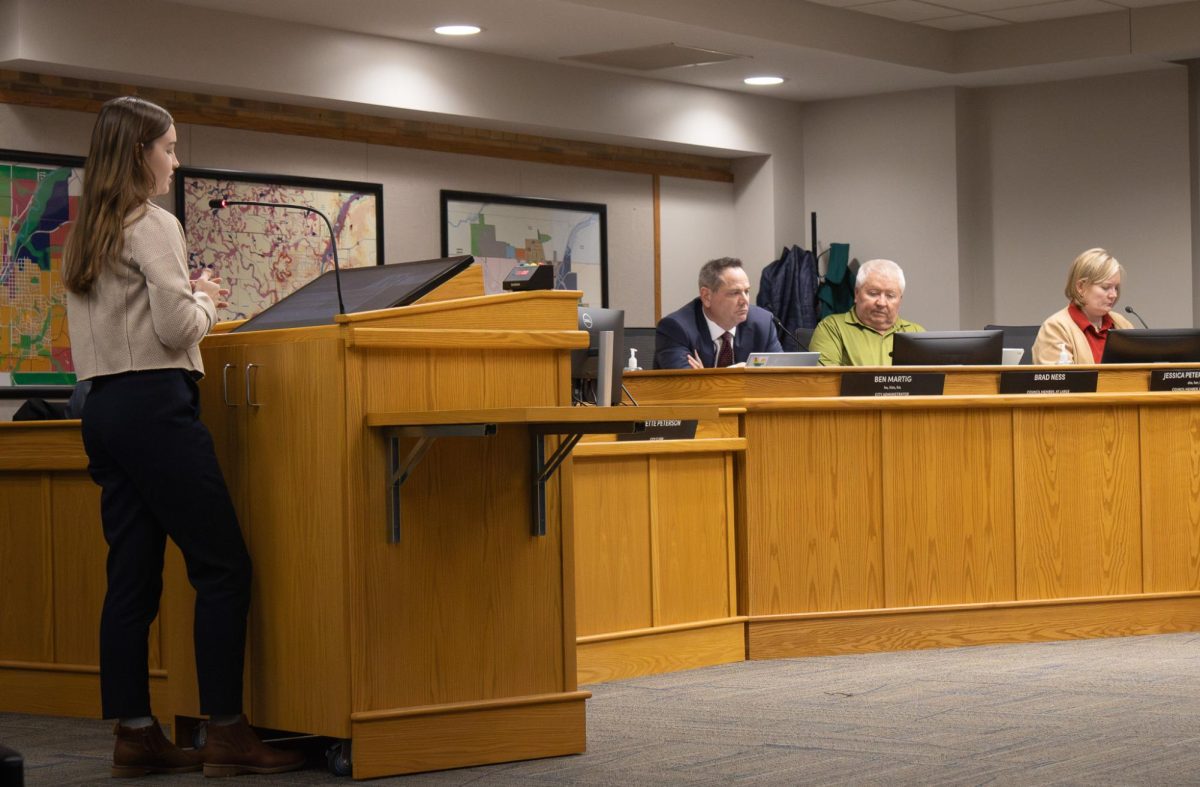
The Northfield City Council voted unanimously March 3 to approve an interim amendment to its Sustainable Building Policy, granting staff flexibility as the city’s climate ambitions collide with a grid that cannot accept new solar power.
Adopted in 2022, the policy is the city’s main tool for cutting emissions from new construction and major renovations. It applies to city-owned projects and to private developments that receive certain forms of city financial assistance, such as Kraewood Flat Apartments.
The amendment allows Sustainability Coordinator Sara Pabich to approve alternative compliance methods when strict application of the Northfield Green Requirement — the specific standards that new construction and major renovations must comply with — will prevent “implementation of the policy’s intent.”
Northfield is one of a small number of Minnesota cities with a carbon-neutral timeline more aggressive than the statewide 2050 goal set by the Minnesota Pollution Control Agency. Its 2022 Sustainable Building Policy requires projects receiving city financial assistance to meet high energy-efficiency standards and evaluate and install on-site renewable energy when applicable — which is typically solar.
Earlier this winter, however, city officials learned from Xcel Energy that the local grid is too congested to interconnect new solar generation for an estimated three to five years. The issue became public after solar panels planned for the new ice arena were denied interconnection.
That backlog, Pabich said, has created “policy tension.”
At the council meeting, she outlined three problem areas: a greenhouse gas calculation requirement that does not mandate reductions, an energy-efficiency standard that is “not clearly achievable,” and a renewable energy requirement that “is not feasible” in the next three to five years due to the long interconnection timelines.
“As a result of all of these different intentions, we kind of summarized it and said that this policy does not effectively support energy emission reductions or climate resilience goals,” Pabich said.
While the council approved the interim fix, Council Member Chad Beumer said he wanted more information about the hard data on the cost of the equipment required to meet the policy versus the longevity of the equipment.
“We all know that the furnace we’re putting in a house now doesn’t last as long as it did 25 or 30 years ago — and energy-efficient equipment is more expensive too,” Beumer said.
Mayor Erica Zweifel countered.
“I will play the ying to council member’s yang, and say that, in addition to that analysis, it’s also important to [consider] the life cycle costs and the reduction of energy costs over the life cycle of the building,” Zweifel said.
Pabich said the amendment is a short-term solution intended to keep projects moving while a comprehensive revision of the Sustainable Building Policy is drafted. That revised policy is expected to return to the council for consideration before Jan. 1, 2027.