In January 2026, St. Olaf was awarded $28,000 from the Minnesota Office of Higher Education (OHE) through a Hunger Free Campus grant. The grant program was established to address food insecurity at private, nonprofit postsecondary institutions and tribal colleges in Minnesota. With the funds, colleges can support food access in a variety of ways, including food pantries, hunger awareness events, and providing information about Supplemental Nutrition Assistance Program (SNAP) benefits that students can qualify for.
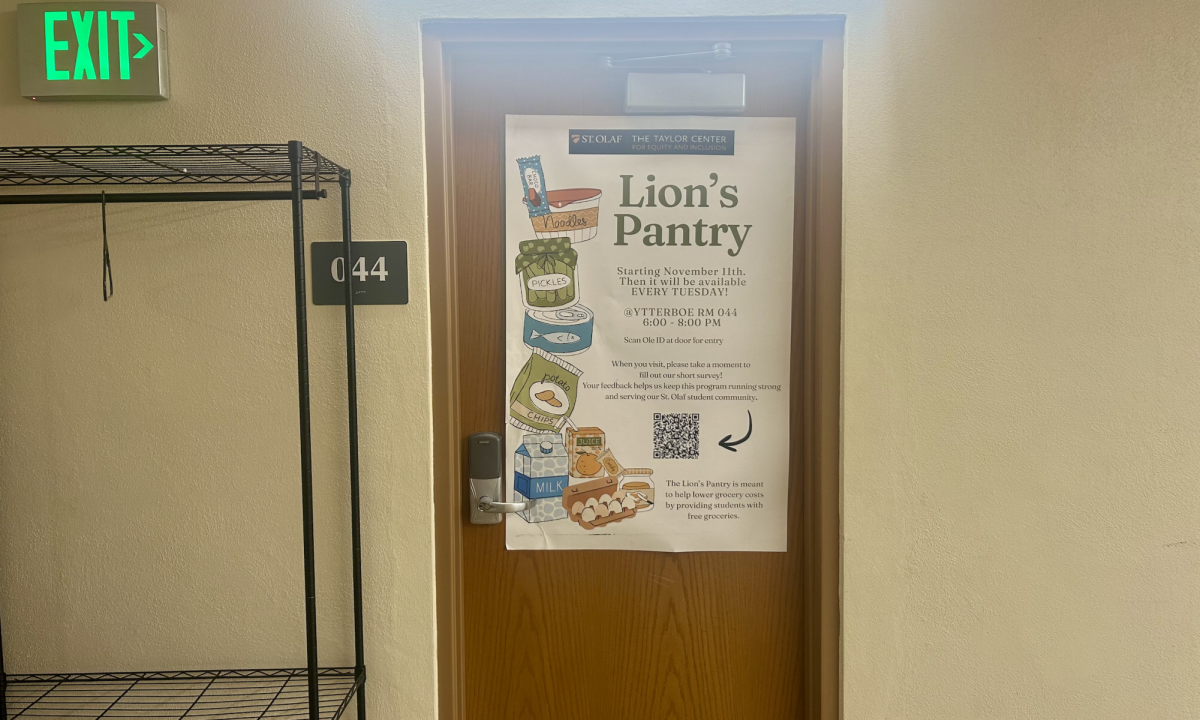
This is the second Hunger Free Campus grant that St. Olaf has received, the first being in 2025. The College has used both grants to support the Lion’s Pantry, which is the on-campus food pantry located in Ytterboe Hall. The pantry was established in 2021, but until the fall of 2025, it was only available to students during breaks in the academic year.
“The main focus is during breaks, including summer,” Director of Public Relations Kat Dodge said in an interview with Power 104.7 FM. “We don’t seek to completely eliminate a student’s grocery bill, but we want to reduce those costs and make sure they have the staples and they can fill in around the edges.”
Now, the Lion’s Pantry has been open year-round for students to use. The pantry previously operated out of temporary spaces on campus, but has been housed in Ytterboe Hall since November 2025.
“The vast majority of the money is going to the pantry and the items within that,” Director of Financial Aid Steve Lindley said in an interview with The Olaf Messenger. “Something that the state funding is allowing us to do is [buy] things that aren’t food, but you need [in order] to cook and make food, such as can openers.”
“The initial funding that we received did go to purchasing the refrigerators, the shelving units … to help kickstart that space,” Associate Director of International Student Programs Brisa Zubia, who also manages the Lion’s Pantry, added in an interview with The Olaf Messenger. “Maybe that doesn’t fall under the realm of food or things that help us cook food, but it served the purpose of allowing us to begin to offer that.”
Not only has the Hunger Free Campus grant supported the sustainability of the Lion’s Pantry, but it has also made its services more accessible and expansive for students.
“Some of the gluten-free and dietary alternatives can be expensive, so we just couldn’t buy [them],” Lindley said. “But now, great, we can get soy milk. We can get gluten-free bread there, so students with those needs can find options.”
Lindley and Zubia have seen the impacts that the pantry is having on students.
“The comments in the feedback form, I mean, continuously students are saying, ‘Thank you so much. This helped lower my grocery bill cost,’” Zubia said. “Especially in the last few months, given the current political climate … we saw a surge in the number of students that were utilizing the pantry on campus [so] they didn’t have to do that shopping outside of this space.”
Lindley and Zubia hope that the Lion’s Pantry continues to grow and support students’ ability to focus on their education.
“It’s harder to feel like a member of this community if you’re worried about where your next meal is coming from,” Lindley said. “So, [we can] reduce the anxiety and stress about food so that you can focus on the other things you need to do to be healthy, happy, and whole at St. Olaf.”
“In the world we currently live in, I think [it’s] the small ways we can show our students that we care,” Zubia added.