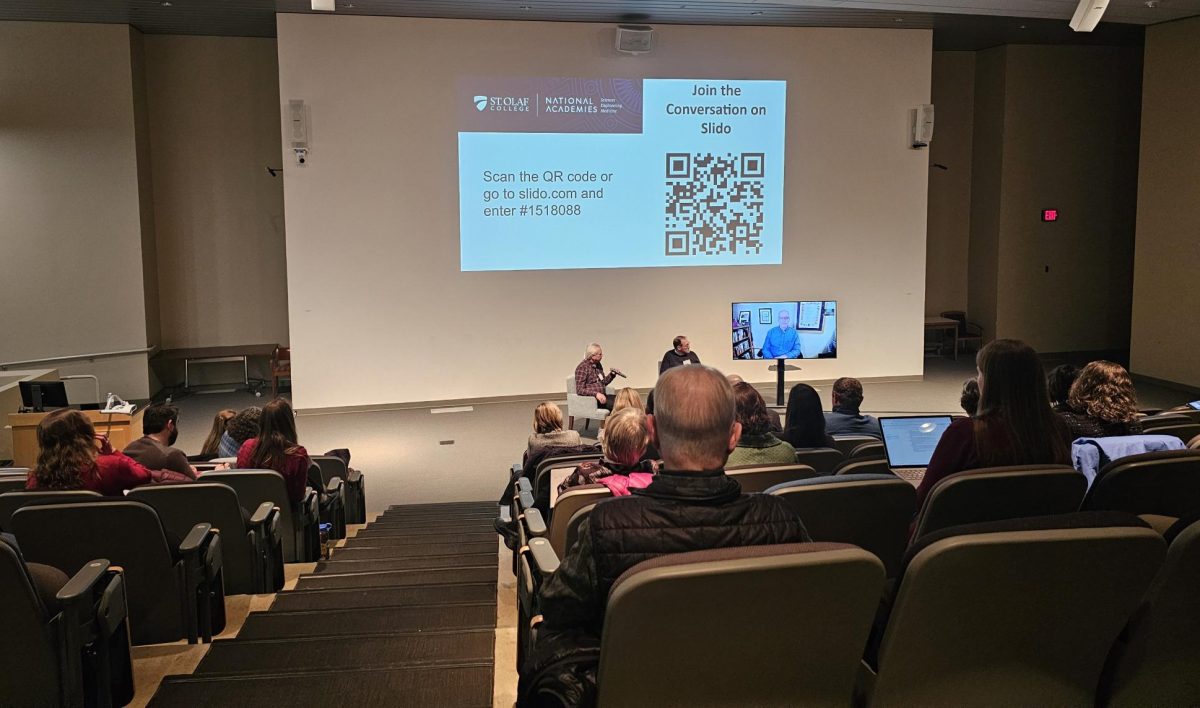
St. Olaf College hosted an education summit over March 13 and 14 to set the broader context for exploring science education in rural communities. The keynote discussion, titled “Envisioning a Bright Future for Rural Education” and hosted by St. Olaf President Susan Rundell Singer, introduced a national comprehensive study with Carleton Professor of Economics Nathan Grawe ’96 and Senior Fellow in the Center for Sustainable Development at Brookings Institution Anthony Pipa. Pipa launched the study, and Grawe worked alongside in economics tracking.
Pipa’s biography on the Brookings Institution website describes the study as offering analysis and recommendations aimed at strengthening the effectiveness of federal policy in supporting rural communities in the 21st century.
The keynote opened with Department Chair and Professor of Education Elizabeth Leer, who discussed the current outlook for education majors.
“Teacher education has been a large part of the history at St. Olaf,” Leer said.
Leer said the education department started in 1911, and from its origin to 1949, 50% of the 5,331 St. Olaf graduates were prepared with a teaching education. In 2004, when Leer began teaching, there were approximately 60 students majoring in education. Present day, there are around 35 education majors. Leer compared this trend to other schools across the country.
“Teacher ed[ucation] numbers have been going down nationwide,” Leer said. “There are a lot of reasons why teaching has become a less attractive position for new graduates; there are fewer people going into teaching and because teachers are leaving the profession at a higher rate than usual.”
With the country experiencing quite a profound teacher shortage, the Reimagining Rural Policy initiative aims to find the shortcomings in rural education, and discover the solutions.
Grawe and Pipa, who joined virtually due to travel and time constrictions, discussed their involvement with the National Academies for the Sciences, Engineering, and Math in a comprehensive study requested by Congress and the National Science Foundation.
The study researched the extent to which federal policy serves rural communities well in their economic and community development.
Pipa defined rurality through a policy perspective; it can be based on the county, which is classified as metro or non-metro. That would define nearly 14% of the country’s population as rural. The Census Bureau categorizes the population based on the census forms with population thresholds, which is around 20% of people.
“‘Rural’ is much more diverse than people give it credit for,” Pipa said. “It is diverse racially, geographically; it is diverse economically.”
A driving factor of the declining numbers for rural student enrollment in higher education include the unemployment rates that students often see after graduation, Grawe reported based on the data.
Overall, there are declines in expected high school graduation rates due to lower birth rates across the country. The expected decline in high school graduates from 2025 to 2041 is a 10% decrease nationwide.
However, rural geographies can continue to see success in their communities.
“As rural youth come out of their high schools, they’re often not really aware of the pathways that are available to them,” Pipa said.
With the increase of artificial intelligence, there is a need for hands-on work.
“We have some of the most acute shortages in healthcare, in service, and in the trades,” Pipa continued.
He suggests that high schools can showcase where the workforce is looking for more hires, such as in those physical locations. Additionally, partnerships are developing among high schools and colleges to help increase college enrollment and support into new careers.
“If we create partnerships that provide opportunities in the rural place,” Grawe said, “I think you’ll see towns and the workforce stay in those rural places.”
The keynote concluded with hope for rural communities through the opportunities that can be provided for them through federal policies.