For Christine Whear ’26, music has always had meaning.
One day, she had been busking when a woman approached her, visibly emotional. The song Whear was playing, the woman said, was one she used to listen to with her sister, who had recently died.
She asked if Whear would play it again. So, Whear did.
For Whear, a senior in St. Olaf College’s Music for Social Impact (BAMSI) major, the experience reflects what drew her to the program.
“It was just this instant connection,” Whear said in an interview with The Olaf Messenger. “This beautiful moment that you can share with a person through music.”
This spring, Whear and three classmates — Ian DiMundo ’26, Kaspar Czuk ’26, and Clara Smith ’26 — will become the first students to graduate from BAMSI, a recently created major that reimagines what it means to study music not just as performance, but as a process of building community.
The major emerged from collaboration between the music department and the College’s civic engagement center, as Professor of Music and Department Chair Louis Epstein, Associate Professor of Music Rehanna Kheshgi, and Svoboda Center for Civic Engagement Director Alyssa Melby worked to move beyond what one of Epstein’s students once described as an “ivory tower” model of music education.
Rather than reshaping the existing music major, Epstein said faculty chose to create a new program that could both expand access to a wider range of students — including those with musical backgrounds outside the Western classical tradition — and reflect the reality of where music-making actually happens.
“A lot of the music that happens in our world is not happening on a stage, right?” Epstein said in an interview with The Olaf Messenger. “It’s happening in people’s homes. It’s happening in public squares. It’s happening in places where people are trying to get things done.”
At its core, the program asks students to think beyond music as a polished product performed on stage and instead understand it as a way to connect.
“Community engagement is messy,” Melby said in an interview with The Olaf Messenger. “This is not an assignment that you can just check off.”
That shift is reflected in how students spend their time.
Alongside traditional coursework like music theory and instrument lessons, BAMSI majors begin building relationships with community partners when they enter the major their freshman year, continuing that work for the next three years.
For Whear, that has meant working with Sabios Cantores, a Spanish-speaking community choir in Northfield. Through her capstone project, she is supporting their rehearsals and helping members co-create an original song about what living in Northfield means to them.
Other students in the cohort have also created projects that connect different parts of the Northfield community. DiMundo has been working with FiftyNorth, a local center for older adults, where music serves as a starting point for conversation between students and residents.
Many of the students’ projects, each unique in its goals and community relationships, share a common reality: they rarely unfold exactly as planned.
“There is an immense amount of flexibility that is required in this work,” Melby said. “I can think of so many instances where students had to pivot and had to rethink what they were doing.”
Both Epstein and Melby contend that this teaches students the time management and coordination skills that a traditional major could not.
For Whear, this flexibility was tested in January, when federal immigration agents were present in Northfield. Sabios Cantores — a group made up largely of immigrants — faced uncertainty about their safety, leading to some rehearsals being held virtually.
Yet, even in all the chaos, they still came together.
“It’s also been so beautiful to see all of the ways that people come together to support their community,” Whear said.
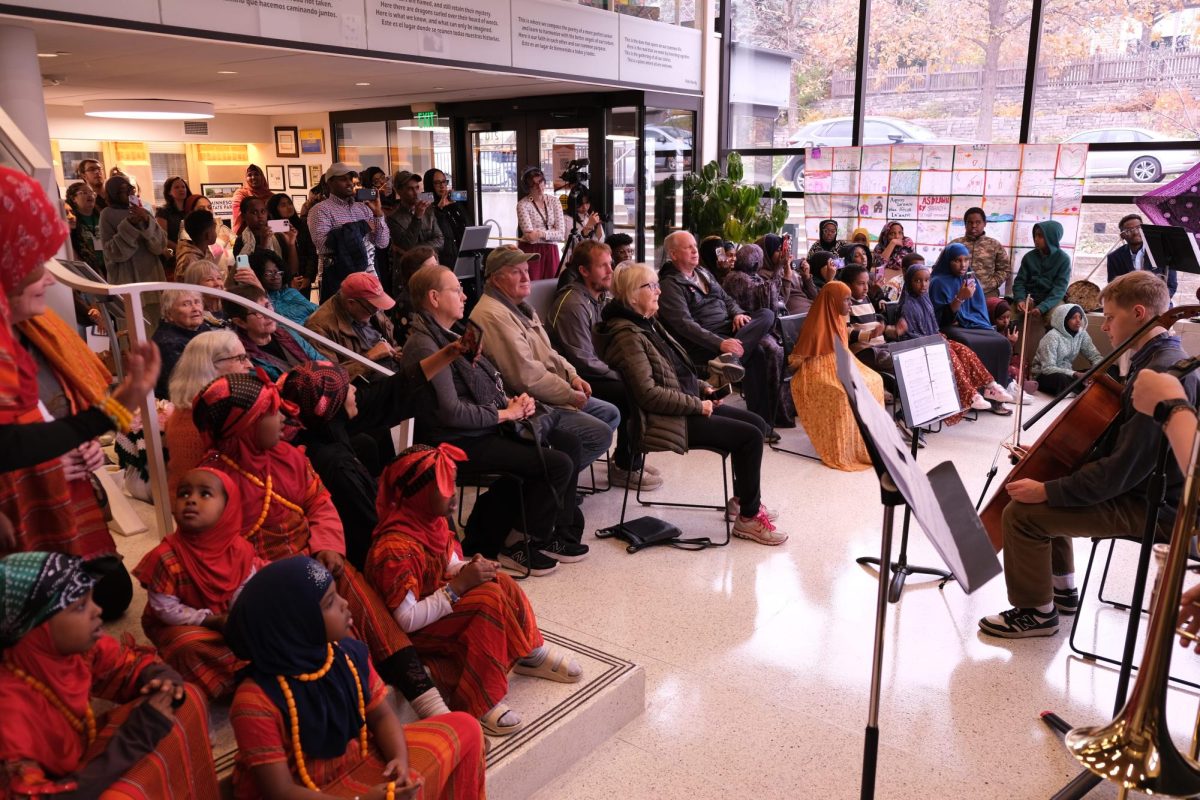
In January, Imminent Brewing hosted a mutual aid concert for Neighbors Supporting Neighbors. Sabios Cantores performed despite fears of federal immigrant presence.
“Some of the stories you heard about what people had gone through that week, and then they still choose to show up and sing their hearts out,” Whear said. “It was incredible.”
Epstein said that type of connection is exactly what the major is designed to create — lasting relationships that allow community members to support one another effectively.
“The folks in the community who were best positioned to help, to have an impact, and to support our neighbors were the people who already had relationships in place,” Epstein said.
For DiMundo, that message is something the program has instilled within him.
“We at the colleges are temporary residents of Northfield. We’re in and out in four years, and it’s just a regenerative cycle,” DiMundo said in an interview with The Olaf Messenger. “We enter, we leave, we enter, we leave, and most of us don’t stay.”
But the residents of Northfield — the people who have lived here their entire lives and participate in community spaces like FiftyNorth — don’t leave. They’re here to stay.
That’s why, for DiMundo, students must learn to support existing community efforts rather than replace them.
“I would expect that whatever the next crisis is, whatever the next moment that our neighbors need our help again, having these relationships and having some of the processes in place,” DiMundo said. “I think it will once again prove really beneficial.”
As the first cohort prepares to graduate, many of their projects will continue — passed down to incoming students or sustained by community partners. But for Whear, the lessons she learned over the last few years will remain.
“I don’t know where that will take me, but whatever I do, it’s always about being so curious about the world and learning from other people,” Whear said.