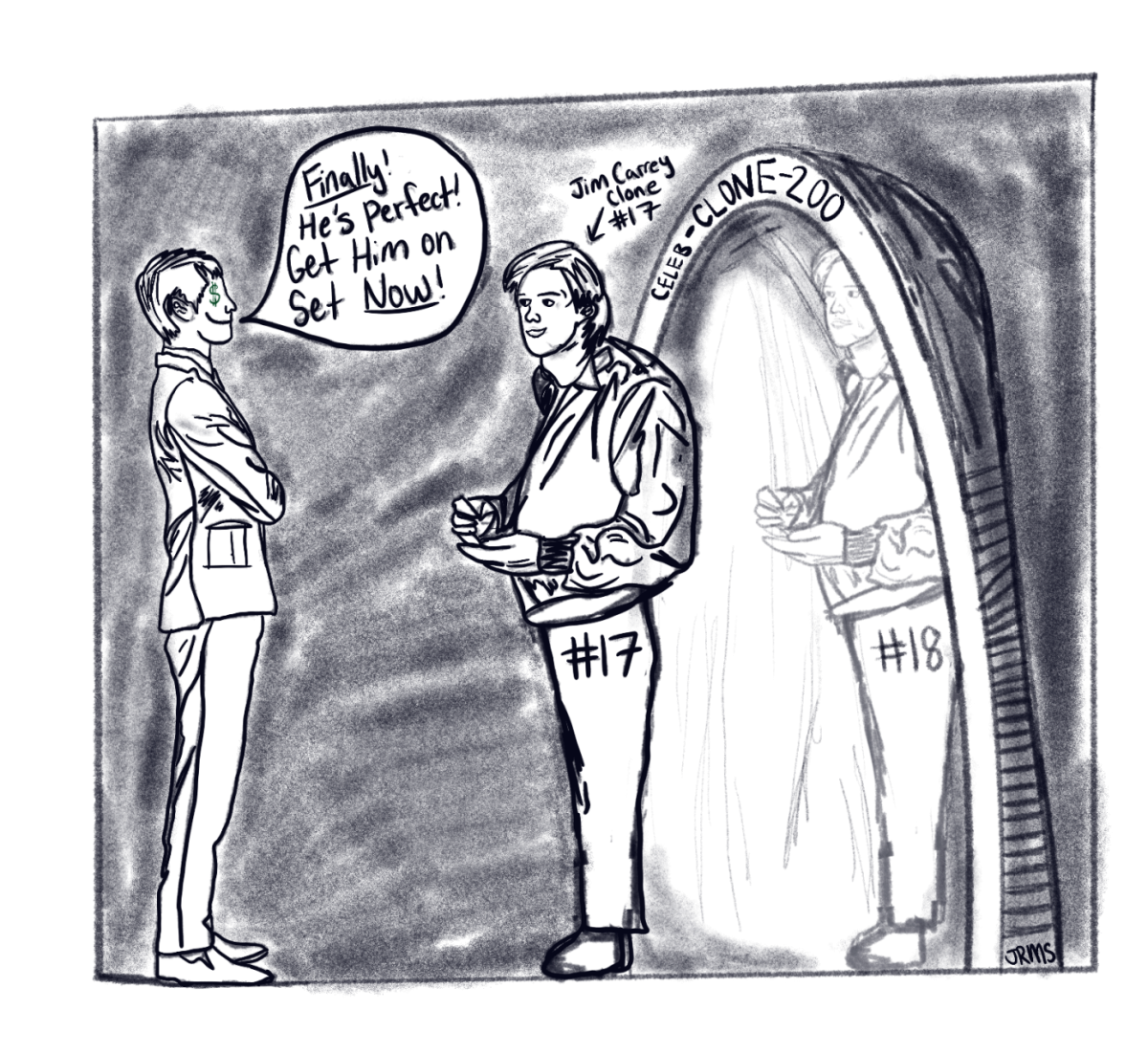
From early conspiracy theories surrounding Avril Lavigne’s alleged replacement to recent claims of Prime Minister of Israel Benjamin Netanyahu’s artificial intelligence (AI) cloning, the internet is invested in the idea of celebrity death cover-ups. One recent celebrity who has fallen victim to this phenomenon is Jim Carrey, whose recent appearance at the César Awards drew concern from online audiences. Carrey showed up to the ceremony looking strikingly different, which, at first, resulted in plastic surgery claims across social media platforms, particularly TikTok. These claims then manifested into “lookalike” speculations, or claims that Carrey was replaced by a body double to attend the event. Some media users even claim that Carrey has passed away, and his team is using a lookalike to carry out his acting career.
I find this resurgence of celebrity cloning conspiracy theories to be deeply problematic for two notable reasons. First of all, these claims play into the toxic, vapid, and parasocial nature of the internet and Hollywood as a whole. We, as movie watchers and content consumers, have no real insight into the lives of these celebrities. Thus, it is ignorant at best and devaluing at worst for us to claim that we can see through these celebrities and their employees. Celebrity cloning theories contribute to an unfounded “we know what you’re up to” mentality, when in reality, no one truly knows what goes on behind the screen, and it may be better to keep it that way. Furthermore, I worry that these conspiracy theories are distracting us from more pressing news stories. To put it simply, theories like these misdirect our attention and waste our cognitive resources.
However, I don’t doubt that these celebrity cloning theories reflect wider social, political, and cultural shifts. In circling back to Netanyahu’s alleged AI press conference, recent speculation surrounding his death, presumed to be from a targeted Iranian missile attack, is symptomatic of a host of worldwide issues. For one, even though the video of an alleged six-fingered, artificial Netanyahu has been proven false, this rapid spread of misinformation has terrifying implications for the future of AI in political spaces. Who is to say how quickly government officials will replace press coverage with AI reports, believable or not, or how quickly AI companies will join billionaires like Jeff Bezos and Rupert Murdoch in monopolizing major U.S. news outlets?
Importantly, Netanyahu’s “AI cloning” is deflecting more attention away from the genocide in Gaza and the Israel Defense Force’s (IDF) continuous human rights violations. In recent months, online hatred towards Israel has been “memefied” or turned into an insensitive catch-all joke. I am sure that most readers have seen the phrase “spiritually Israeli” used to describe someone unlikable or “I blame Israel” used after experiencing something unfortunate. I don’t doubt that Netanyahu’s infamous “AI clone” is grounds for more “memification.” While the prospect of AI news reports is deeply concerning, conversations surrounding Israel and Israeli news footage should instead be centered around denouncing the propagandization and dehumanization of Palestinians.