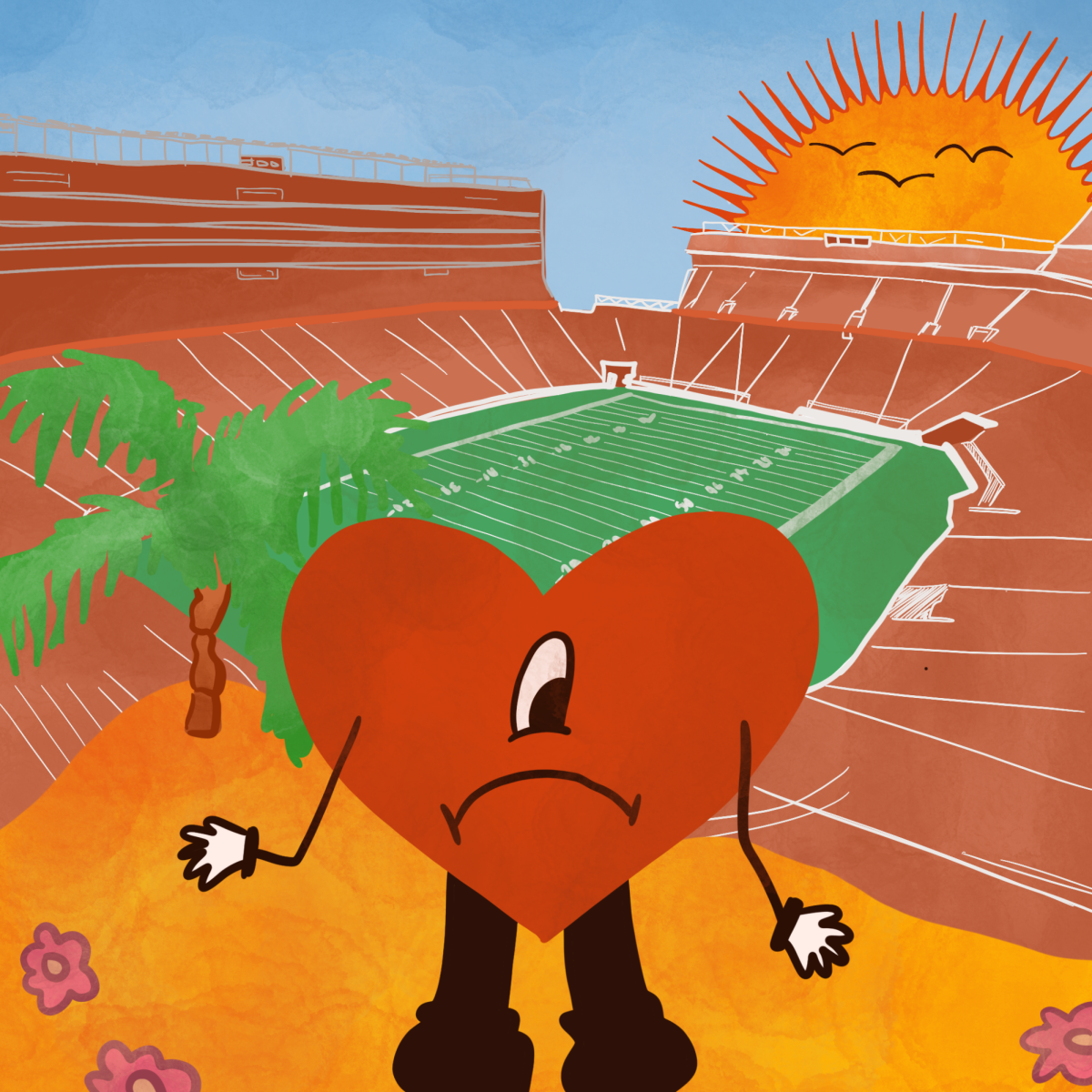
On Sunday, Feb. 8, Bad Bunny’s halftime performance, rooted in cultural storytelling and resistance, took a strong stance against the United States’ deep-seated racism, xenophobia, and ongoing political oppression. In case you missed them, here are a few key historical, cultural, and political moments that contributed to its incendiary success:
- The show was largely intended for TV audiences, with the set design and camera angles working to create a cohesive storyline for the viewers. The viewers began their journey in tall sugar cane stalks alongside farmers in traditional pava (straw) hats, a nod to the iconic jíbaro farmers of Puerto Rico. The sugar cane stalks remained in view throughout the entire performance, serving as a reminder of the island’s colonial past, with the fields of workers symbolizing the slavery endured by the indigenous Taíno people following Spanish colonialism in the 1500s.
- While singing his opening song “Tití Me Preguntó,” Bad Bunny navigated his way through a piragua stand, nail salon, construction site, and domino stand, amongst other cultural representations of Puerto Rican neighborhoods. The piragua stand paid tribute to Puerto Rico’s beloved shaved ice dessert, the nail salon and construction site to the businesses oftentimes anchored by Latino workers, and the domino table to the popular neighborhood game. Nearing the end of the opening scene, the viewers met a young couple who officiated their wedding during “MONACO” and were seen celebrating with real family and friends during “BAILE INoLVIDABLE.” Notably, Bad Bunny’s representatives have since verified that he served as their official witness and signed their wedding license.
- Lady Gaga made a guest appearance wearing a light blue dress reminiscent of the light blue triangle in the authentic Puerto Rican flag. The original flag was made illegal in 1948 under heavy influence by the U.S. government as a way to suppress Puerto Rican independence, and the flag has since been substituted with the dark blue shade of the United States’ flag. Therefore, the performance’s use of the light blue flag makes a purposeful statement against the United States’ history of political suppression in Puerto Rico.
- After Lady Gaga’s appearance, the flag was displayed in the window of a vendor’s stall, in which Bad Bunny was handed a shot by Toñita, a Latina cultural icon and longtime friend of Bad Bunny. This iconic moment referenced Bad Bunny’s acclaimed song “NUEVAYoL,” in which he mentions taking a shot in Toñita’s Caribbean Social Club in Williamsburg, Brooklyn, which has served as a safe haven and cultural hub for Puerto Ricans and Latinos since 1974.
- Towards the end of the performance, Bad Bunny climbs onto a power line while singing “El Apagón” and “CAFé CON RON,” referencing Puerto Rico’s faulty electricity grids and energy policies following Hurricane Maria in 2017. In the show’s climactic ending, Bad Bunny exclaimed, “God bless America,” and listed the countries of North and South America, symbolizing the unity of the American continents and dispelling the narrative that the United States is the one true “America.” To highlight a seemingly minor yet impactful detail, Bad Bunny shouted out Haiti using a silent “H,” paying respect to the authentic French pronunciation and offering a subtle lesson on the importance of respecting linguistic and cultural differences. Closing with the title track of his Grammy-winning album “DeBi TiRAR MáS FOToS,” the words “the only thing more powerful than hate is love” were displayed across the scoreboard, ending the performance with a final reminder of Bad Bunny’s purpose as an artist, activist, and American citizen.
Story continues below advertisement