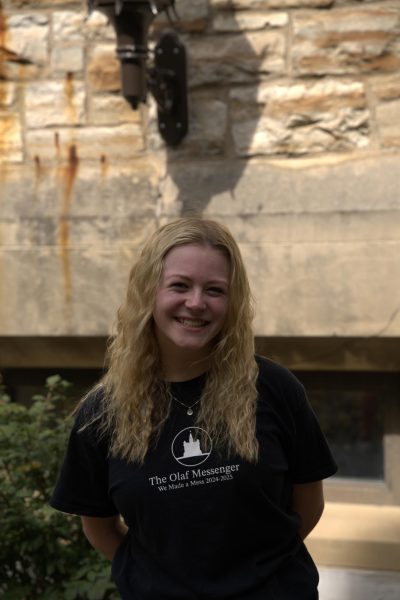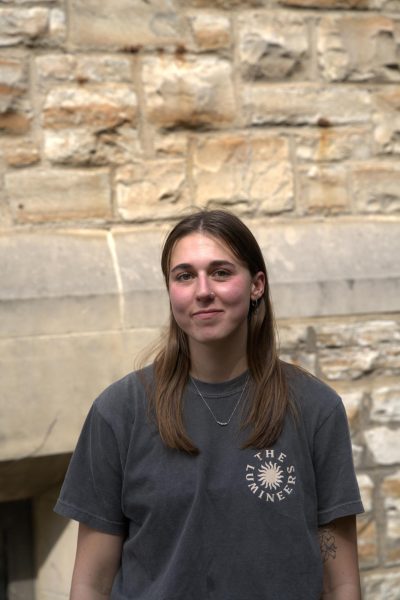
Lola Buckley ’27 planned to major in Russian before she even arrived at St. Olaf. She was born in the United States, but raised overseas her whole life, residing in many different countries. During her time living in Moldova, Latvia, and Uzbekistan, she was surrounded by the Russian language.
When her college search began, she knew she wanted to study Russian alongside her interest in international relations. St. Olaf’s Russian language program stood out to her.
The evolution of the Russian language major
When Buckley arrived in the fall of 2023, the Russian department was already on shaky ground.
Longtime tenured Russian Professor Marc Robinson, who had built the Russian program into what it was, had recently retired. Just months into the academic year, students learned through unofficial channels — not from administration — that the contracts of the two remaining Russian language professors, Anna Pearce and Maxwell Parlin, would not be renewed. The department would be left without any language faculty.
The College’s original plan was to replace them with a single professor. However, with the limits on how many courses one faculty member can teach per academic year, many students would not be able to complete their degrees.
“There was a lot of panic at the time because communication was not clear, and we were getting it from different sources,” Elle Davis ’26, one of two senior Russian language majors, said in an interview with The Olaf Messenger. “We were in limbo for, like, two months.”
During this time, students considered leaving. Both Buckley and Davis looked at transferring — Buckley to the University of Virginia (UVA) and Davis to the University of Minnesota, but even that option was complicated.
“I spoke to one of the professors [at UVA],” Buckley said in an interview with The Olaf Messenger. “And he even said that UVA, a huge state school, was receiving budget cuts and he wasn’t sure if he was going to be replaced.”
Buckley stayed; a decision shaped as much by finances as anything else.
Students who stayed in the program fought back. Eventually, St. Olaf agreed to hire two new professors. Students like Buckley and Davis who had already declared the major would be able to complete it under the catalog they came in on.
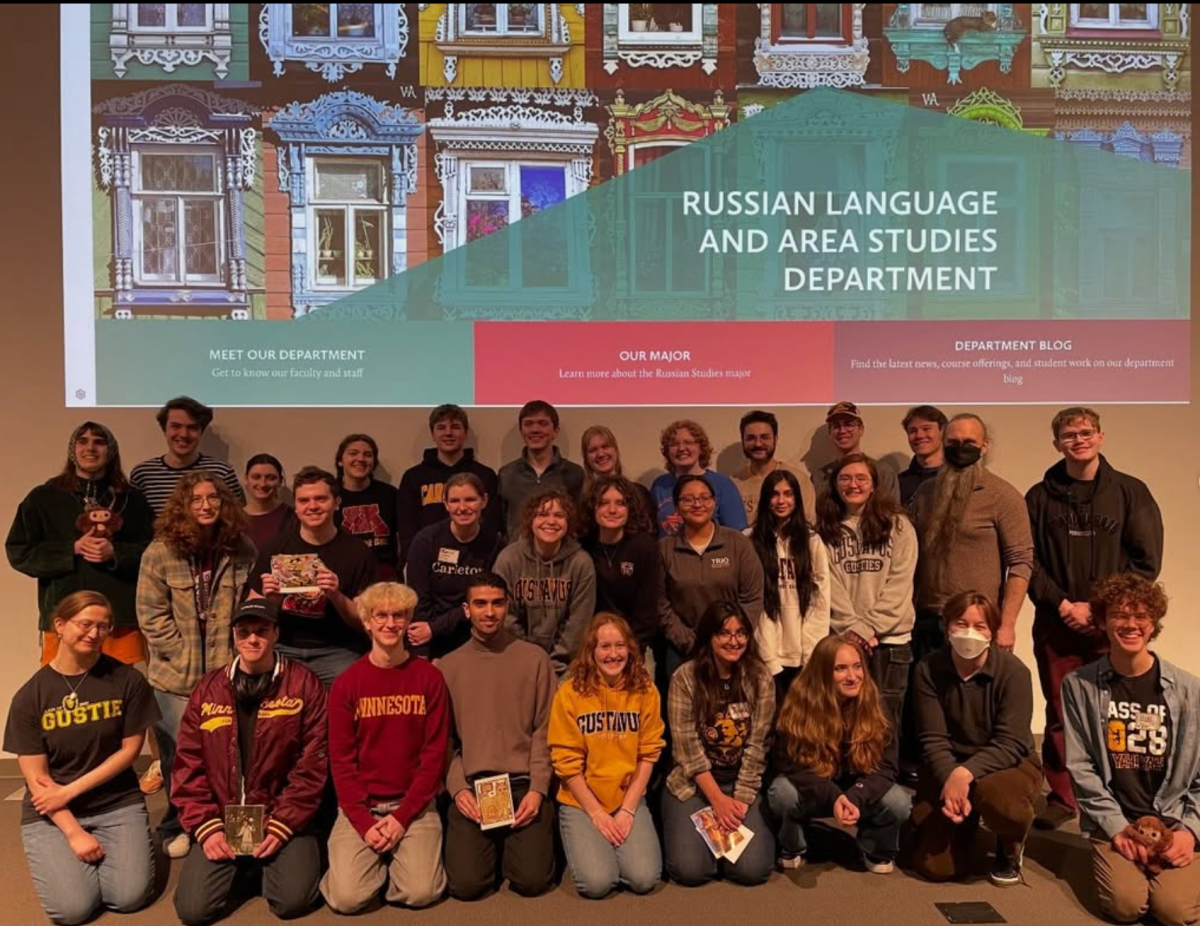
But the damage was done. Many students had already dropped the major due to months of uncertainty. There are currently only five Russian language majors remaining, with no admittance in the major for incoming class years. After the class of 2027 graduates, the Russian language major will be phased out.
“They are going to take away the thing they advertised, that they promised to you,” Davis said. “I should be focused on my education, not trying to figure out whether I will receive what I was promised.”
Enrollment problems didn’t start with the faculty shakeup. Russian language enrollments had been declining for years. The major peaked at eight graduates in 2022 and has fallen steadily since: three in 2023, two in 2024, and one in 2025.
Visiting Assistant Professor of Russian Language and Area Studies Giulia Dossi points to several factors influencing the decreasing enrollment.
“There was a lot of turnover in the faculty, which probably partially contributed to the enrollment problem — and Russian language enrollment [dropping] was just a national trend,” she said.
The major itself also differs from other language major requirements, making it a more demanding educational path. “It requires a lot of years of Russian, [and] it has [a] mandatory study abroad,” Dossi noted.
Course availability also became a self-reinforcing problem with the limited faculty to teach.
“If you look at the course bucket in SIS, they don’t offer 95% of those classes anymore, and they haven’t since, like, 2017,” Davis said.
The broader St. Olaf language landscape isn’t promising. Across the College, foreign language, literature, and linguistics majors accounted for 6% of Bachelor’s graduates in 2025, down from 7.2% in 2020. Spanish remains the most popular world language with 15 graduates in 2025, though that’s down from a high of 24 in 2022. French has seen a similar drop from 14 graduates in 2022 to just seven in 2025.
Nonetheless, Buckley, who is also a French major, sees a stark contrast between the two programs, noting the variety of different courses and cultural classes.
She attributes the difference largely to the French department’s established foundation. Students engage with it more freely because it doesn’t feel temporary. Dossi gives St. Olaf cautious credit.
“St. Olaf is still carving out a space for the languages, much more than other places. It could definitely be more, but St. Olaf is doing an okay job.”
The importance of a Russian major
Russian is the ninth most spoken language globally, with 255,000,000 native and second language speakers.
“It’s a language of the UN [United Nations], it’s a critical language of the U.S. state department,” Davis said. “It has a lot of value; 25% of scholarly material is published in Russian.”
Furthermore, Davis commented on the value of the Russian major for a liberal arts institution.
“I think learning Russian fits into the mission strongly, and that’s why it’s so disappointing that it was taken away,” Davis said. “[It was] an opportunity for students and for the college.”
In 2016, the St. Olaf Board of Regents established the College Mission Statement, encouraging students to explore their education and vocation in an “inclusive, globally engaged community.” For the College to live out their mission, the Board of Regents states the College offers opportunities for international and domestic off-campus study connected to an emphasis in the curriculum on language, culture, and place.
“This is the idea of cultural competency, right?” Dossi said. “You learn about how to behave if you were to travel or interact with people that speak the language, and [in] the case of Russia … it is a very complex reality.”
Engaging in a language and the culture associated with it is crucial for the development of global citizens.
Acquiring a second language is different from developing a native language. Native speakers develop their language skills in their first years of life after babbling and mimicry of the language around them. Developing a second language skillset follows different psychological processes, including the initial necessity of a silent period and learning basic, formulaic expressions.
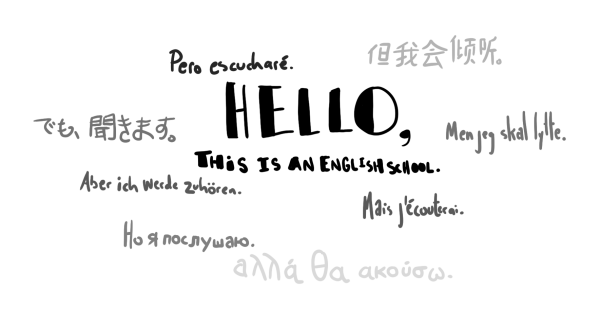
“You have the experience of just being like a child again; you are this intelligent, complicated person, and you’re trying to express yourself in a language that’s not your native language, and it’s very vulnerable,” Dossi said. “It’s very hard. And I think just having that experience is just fundamental for St. Olaf’s mission of being a better person.”
Dossi further elaborated on the difficulties with learning a second language.
“[With] Russian, [or] any language really, sticking to it shows that you can work hard and you’re sticking with something; you’re dedicated to it and committed to the process of learning something difficult,” Dossi said.
However, Dossi also pointed to a new threat on top of the difficulties of learning a language: AI.
“I think especially with AI … all languages are a little bit struggling. There’s this belief that you don’t need to learn a language. You can just use AI to translate for you. And of course, AI cannot master cultural competency,” Dossi said. “[The language is] spoken in Russia; it’s spoken in a bunch of countries that were either colonized by Russia or in different periods, imperial or Soviet. AI cannot explain all of that.”
The influence of current events on the major
The current conflict between Russia and Ukraine arose in 2014 and escalated to the present Russo-Ukraine War in February 2022. The Russian Language and Area Studies department condemns the ongoing aggressions by Russia.
Davis reflected on the presence of a Russian department amidst current events.
“It’s a distinguishing factor if your college has a Russian department, I think especially now,” Davis said. “There’s always been adversarial relations between the Russian political polity and the political polity in the United States, and I don’t think that’s going away, especially not after 2022 when the war inUkraine started,” Davis continued, “so you need people in this country to be able to speak Russian.”
Davis acknowledged the large Russian immigrant community in the United States and how connecting with others in their language can develop one’s vocation — something the College’s mission strives to help students achieve.
“Diversity of language is so important; why would you shy away from solving the world’s problems? You can’t solve that without communication, and how do you communicate?” Davis said. “Through language. It’s an asset to know both English and Russian.”
What does Russian look like at St. Olaf today?
The Russian department aims to support remaining language majors throughout the adjustment process.
“This is a transitional period for us,” Dossi said. “[I]t would be great to have enough students at that higher level [of language] … and it would be great if we could get to the place where we have enough students every year at a higher level to regularly offer higher levels of Russian.”
There are currently not enough students to be able to consistently offer higher levels of Russian language courses.
“Once you get to advanced Russian, it’s very hard for us to meet the needs of someone who is at a third-year level,” Dossi said.
While the department waits for more students to fill a course in higher Russian language courses, Morse and Dossi offer Language Across the Curriculum (LAC) courses — personalized, quarter-credit courses paired with a course taught in English. Students meet with faculty once weekly to read texts in the language.
In addition to LAC courses, Dossi is in the process of developing a new program intended to support Russian language learners.
“We’re really excited about this,” she said. “Next year we’re going to launch a speaking partner program, where we’ll recruit six or seven native speakers at St. Olaf to weekly meet [with students].”
Morse and Dossi plan to create conversation prompts for students who are interested in a weekly, hour-long conversation practice.
“It will allow you to keep what you got and not lose it,” Dossi said.
Dossi said if the language major were to be reintroduced, the department would likely adapt it and create a more flexible version. However, as of now, Dossi, along with Morse and Visiting Associate Professor of History Erich Lippman, plan to build the department back up, beginning with the Russian area studies major.
With the new administration at St. Olaf, Buckley and Davis worry about a lack of emphasis on language majors. The College seems to be investing elsewhere. A new neuroscience major will be added in fall 2026. The administration, Board of Regents, and faculty are discussing engineering and business majors. A primarily STEM-focused makerspace is in the works.
“I just think, you know, there are places that administrations are threatening to cut entire humanities departments or New Hampshire College is closing completely, which is a small liberal arts college,” Dossi said. “So it feels like everyone’s in danger.”
Buckley reflected on how she feels her Russian major is viewed.
“I absolutely think that [people] think my Russian major is just fluff,” Buckley said. “Do you remember the activity they made us do in SOAR [Student Orientation to Academics and Resources] … you plugged in your major, and you got your careers. I plugged in Russian, and I got ‘Amazon warehouse’ and ‘Caribou barista’ … [with the] sticker price, I am paying $81,000; why would you tell me that my major is going to get me working at Amazon?”
“If I was an engineering major, I would plug it in and get all these lucrative jobs,” Buckley continued. “STEM … that’s just not our identity … [The College is] moving away from their identity that they are selling. We don’t stand out anymore.”
Davis supported Buckley’s statements on the shift.
“From a student’s perspective, I would be pretty frustrated to see that identity shift … and that’s why there was so much confusion and concern in the Russian department.”
Russian departments around the country are seeing these changes.
“We have the second highest level of people studying in the Peace Corps and a high level of international students,” Buckley continued. “This is our identity, not just humanities, but also international engagement. I think we have just erased that. That made us special.”
Despite the shifts in the Russian language department, Dossi remains hopeful in rebuilding the program.
“[It] kind of seem[s] like humanities are at a risk everywhere, right, but Russian studies is trying to figure out where to go next,” Dossi said.
With the damage from the Russo-Ukraine War, she said that it “shook [the department] awake.”
“Russian studies for years, in America, in the United States, it’s been dormant, it’s been like the same thing that it’s been doing for the past 50 years,” Dossi said. “And this was like a rude awakening, like ‘wait a minute, what, we can’t keep doing the things in the same way.’”
Dossi said the program recently shifted to talking about post-colonialism, how Russian is a global language, the diversity within the Russian-speaking world, and expanding the curriculum, including the name “Russian” department itself.
“So I think that the one silver lining of coming here at a moment of crisis for Russian at St. Olaf is that we were kind of given a blank slate to build a new program that is more in line with the current political situation and the values that I think should be shaping the field going forward,” Dossi said.
As a graduating Russian language student, Davis wants aspiring language majors to advocate for their learning.
“Look for immersion opportunities because there’s no replacing that,” Davis said. “You unlock so much with every language you know.”